
Patient Care
This is the panel you live in. Target any player and choose Patient Care.
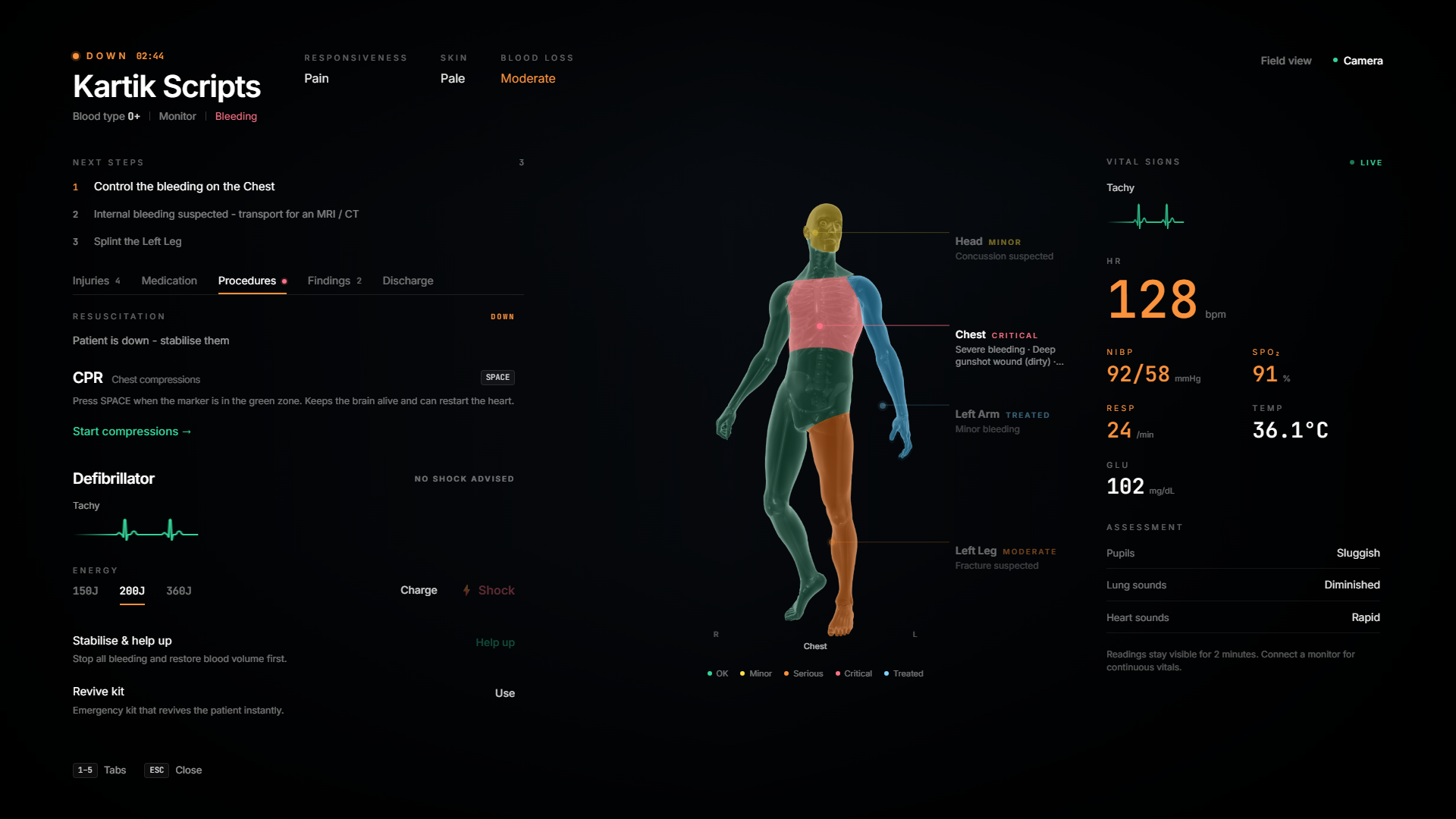
🧭 Next steps, read this first
The column on the left is the whole tutorial. It looks at the patient's actual state and lists, in order, the most urgent things to do right now.
"Control the arterial bleeding on the right arm" "Check for a pulse" "Clean the laceration on the left leg before it gets infected" "Confirm the suspected fracture with an X-Ray"
Life threats go to the top, in order: airway, then breathing, then circulation, a closing airway before a tension pneumothorax, a tension pneumothorax before a bleed. See Trauma & Life Threats.
A new medic can run a full call by doing nothing but working down this list. It updates live after every action.
🖥️ Two layouts
| Layout | |
|---|---|
| Field (default) | An overhead body view with markers on the injured parts. Every injury is listed with its own recommended treatment next to it. Fast, compact, good for a roadside. |
| Panel | A full chart window with tabs. Everything at once, better for hospital work. |
Switch between them from the panel header at any time. Server owners set the default with Config.UI.patientLayout.
The inspection camera
In panel layout, your camera focuses on the patient and follows whichever body part you select. Click the left arm and the camera moves to the left arm.
Toggle it in the panel header, or turn it off server-wide with Config.UI.inspectCamera.
📈 Vitals
Vitals stay blank until you measure them. Click a blank reading to use the tool for it, if you have one. Next to the numbers sit Pulse (by hand), Airway and Ultrasound (FAST).
The pulse, airway, stethoscope and ultrasound readings open a hands-on check, the chart hides while it runs and comes back with what you found.
📑 The tabs
Injuries
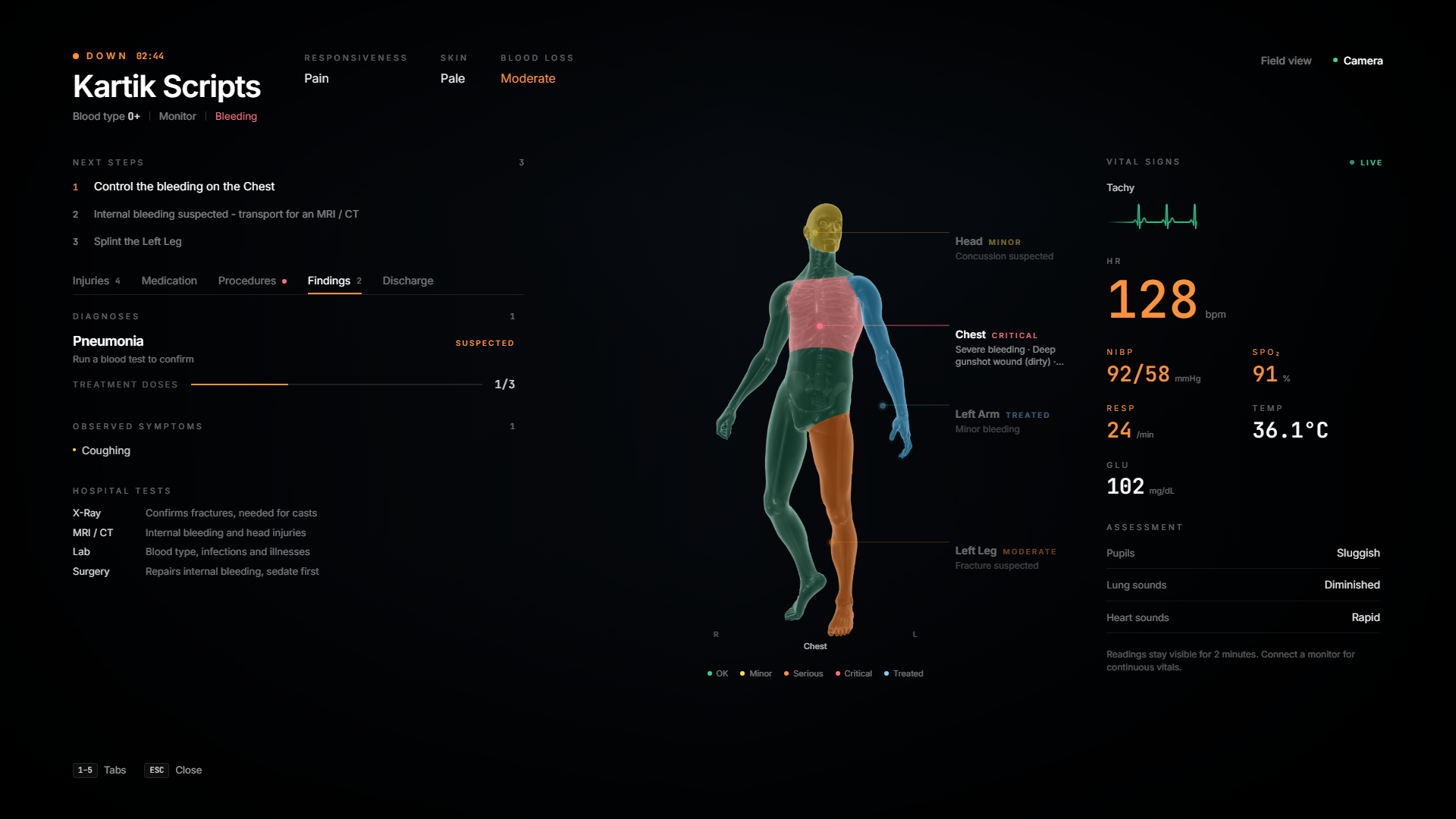
Click a body part to see what is wrong with it and what you can do. The panel only offers treatments that are actually valid for that injury, you cannot suture a bruise or splint a chest.
Items are taken from your pockets, or from a deployed medical bag within 5 m, or free if you are in a hospital.
Full reference: Treatments.
Medication
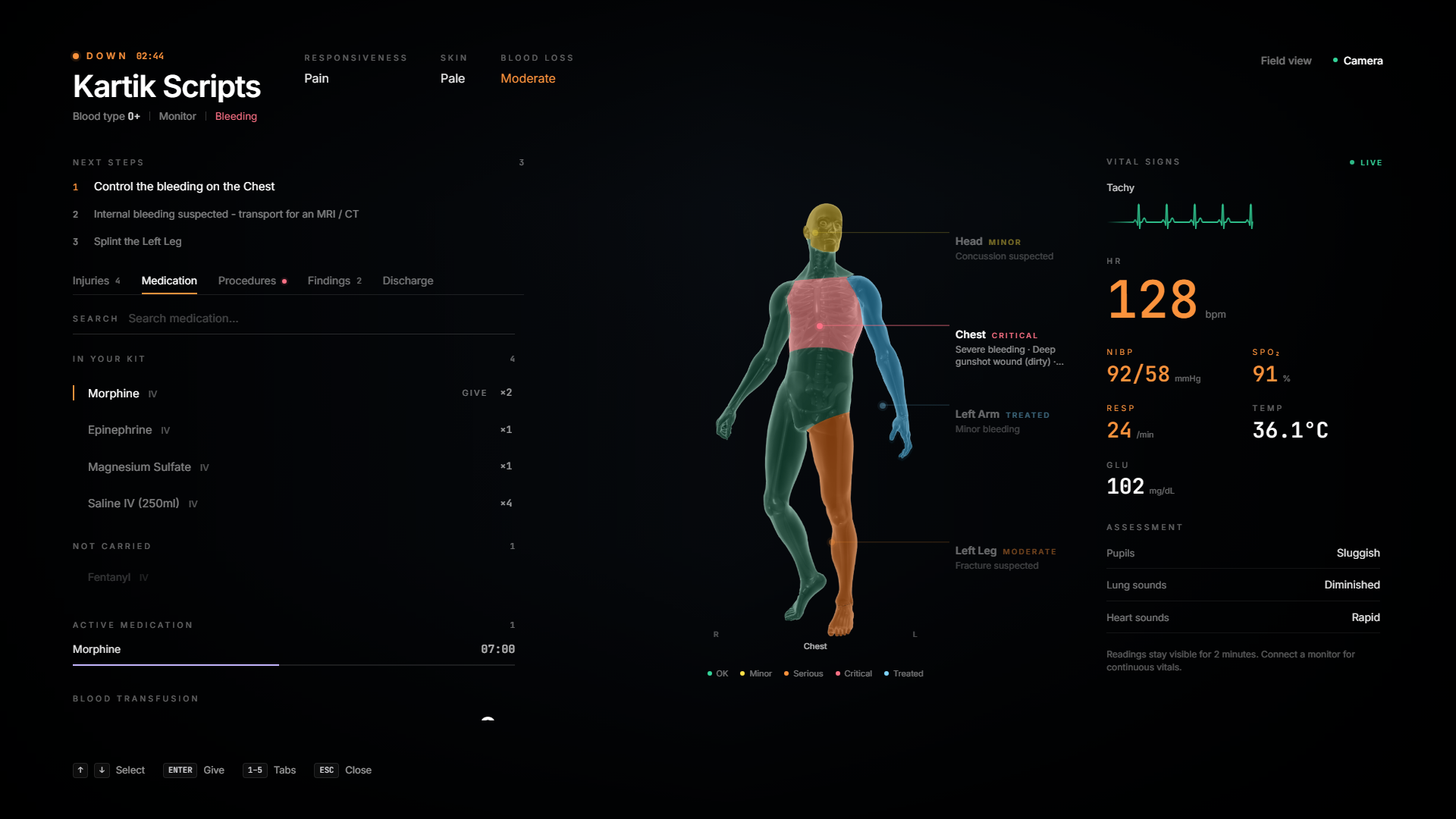
Drugs are given to the whole patient, not a body part. Each one shows its route (IV, Oral, Nasal, SubQ, Inhaled, External), its class, and what it treats.
Full reference: Medications.
Procedures
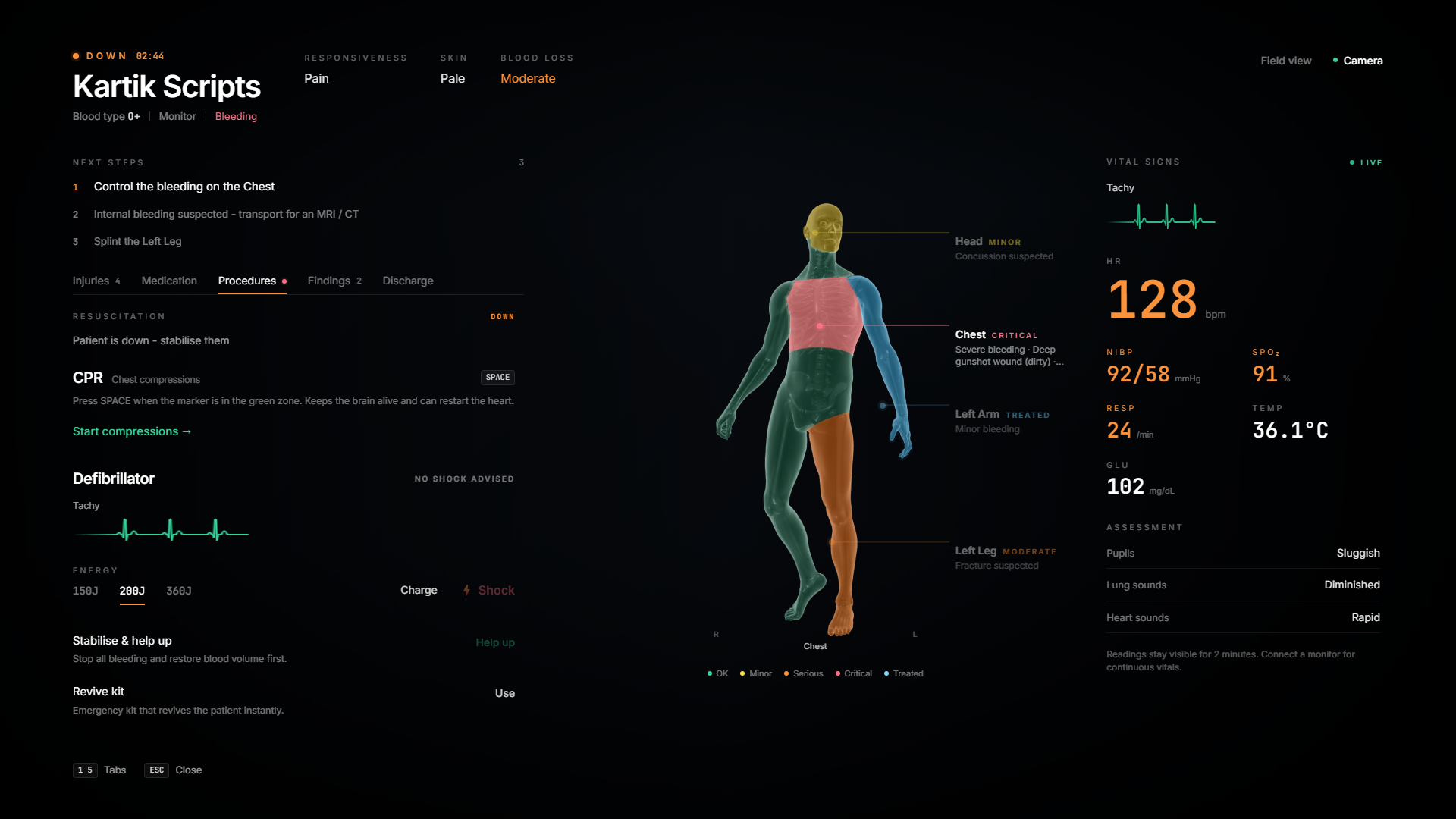
| Procedure | |
|---|---|
| CPR | Rhythm minigame. Extends their timer, can convert a flatline |
| Defibrillator | Charge, pick your joules, shock |
| Help up | Bring a downed patient back to their feet |
| Draw blood | Fill a blood tube for the lab |
| Patient monitor | Connect them to a deployed monitor for live vitals |
| Stretcher | Load them onto a stretcher |
| Bed | Move them into a hospital bed |
| Body bag | For the ones you could not save |
Findings
Everything you have discovered so far, measured vitals, palpated fractures, confirmed diseases, test results. This is the evidence trail, and it feeds straight into the report.
Nothing appears here for free. If you have not measured it, you do not know it. A patient's blood pressure is blank until you put a cuff on them.
Discharge
Where the encounter ends: pick mobility, bill the patient, write a prescription, and save the report. See Discharge & Billing.
🩻 Where your supplies come from
When you apply a treatment, the script looks for the item in this order:
- Your own inventory
- A deployed medical bag within 5 m
- Hospital stock: if you are inside a hospital, diagnostic tools are free (
freeInHospital) - Your ambulance: standing within 8 m of one counts as carrying the tools (
freeNearAmbulance)
This applies to tools, which are never consumed. Consumables, bandages, medication, sutures, always come out of a real inventory somewhere.
🔒 Safety limits
| Limit | Default |
|---|---|
| Maximum distance between medic and patient | 6 m |
| Cooldown between treatments from the same medic | 1.5 s |
These are server-side. A patient who runs off mid-treatment interrupts it.
🦴 Working with a broken arm
You are not exempt from your own system.
| Broken arms | You cannot |
|---|---|
| 1 | Carry a patient, perform CPR |
| 2 | Also drag a patient or push a stretcher |