
Cardiac Arrest
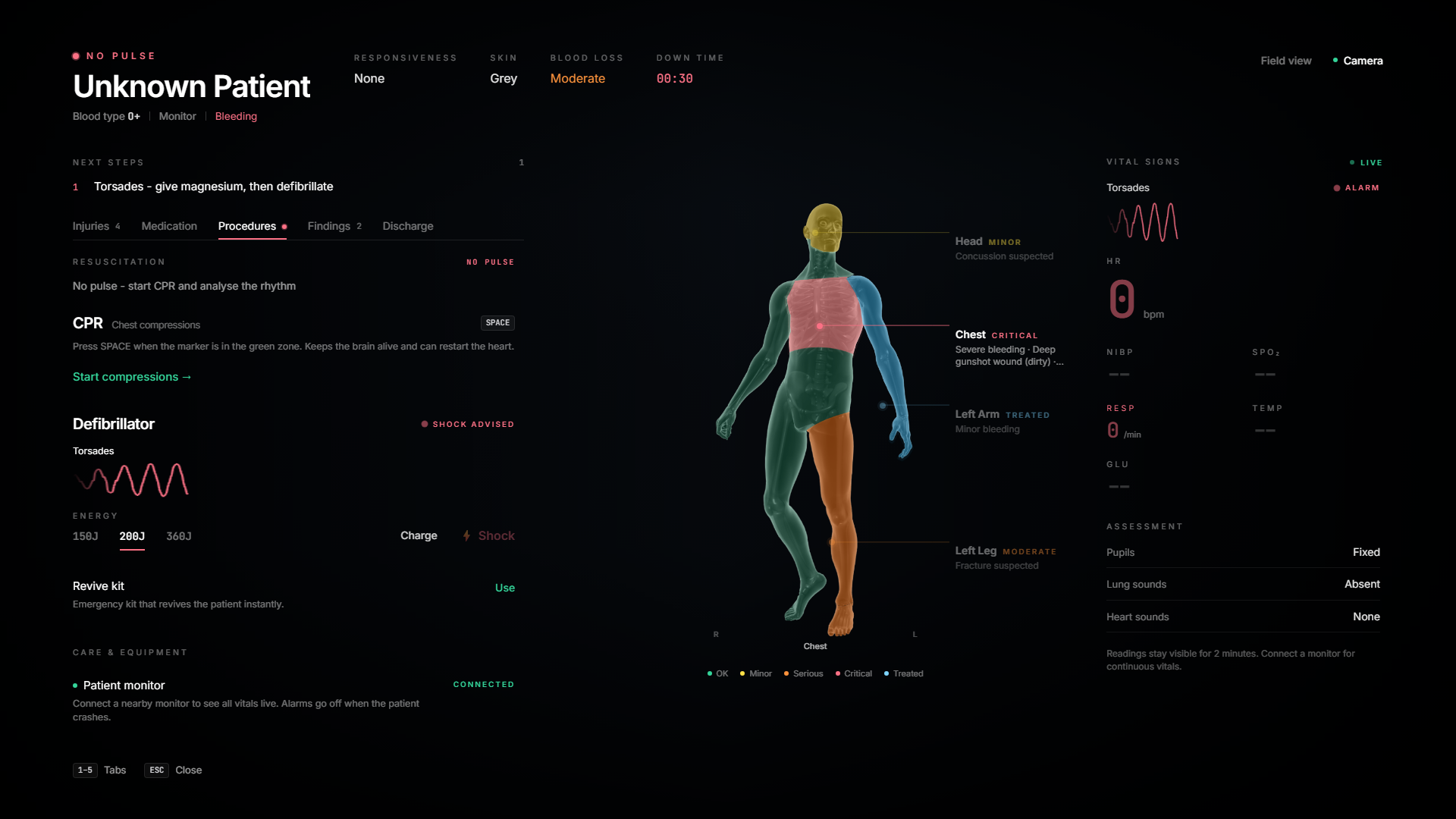
When a patient dies, their heart does not just stop, it goes into a specific rhythm, and that rhythm decides whether you can shock them or not.
💓 The five rhythms
The rhythm is rolled from how the patient died.
| Rhythm | Shockable? | |
|---|---|---|
| Ventricular Fibrillation (VFib) | ✅ Yes | The classic shockable arrest |
| Pulseless VT | ✅ Yes | Slightly better odds than VFib |
| Torsades de Pointes | ✅ Yes | But with a −30% penalty unless you give magnesium |
| PEA | ❌ No | Electrical activity, no pulse. CPR, epinephrine and fluids |
| Asystole | ❌ No | Flatline. CPR can convert it back to something shockable |
🎲 What causes what
| Cause of death | Likely rhythm |
|---|---|
| Default (gunshot, trauma) | VFib 60% · Pulseless VT 25% · Torsades 15% |
| Blood loss | PEA 65% · VFib 25% · Asystole 10% |
| Drowning | PEA 45% · VFib 30% · Asystole 25% |
| Taser | VFib 80% · Torsades 20% |
| Burns | VFib 70% · Pulseless VT 30% |
| Overdose | PEA 50% · Asystole 30% · VFib 20% |
| Tension pneumothorax | PEA 80% · Asystole 10% · VFib 10% |
| Cardiac tamponade | PEA 85% · Asystole 15% |
| Blocked airway | PEA 55% · Asystole 35% · VFib 10% |
Notice the pattern: violent deaths give you something to shock, slow deaths do not. A patient who bled out is most likely in PEA, reaching for the defibrillator is the wrong first move.
⏳ The window
After death the heart stays in its arrest rhythm for 150 seconds, then degrades to asystole.
PEA lasts 1.5× longer than shockable rhythms before degrading.
You have about two and a half minutes of a shockable rhythm. After that, you are doing CPR to earn one back.
🫀 CPR
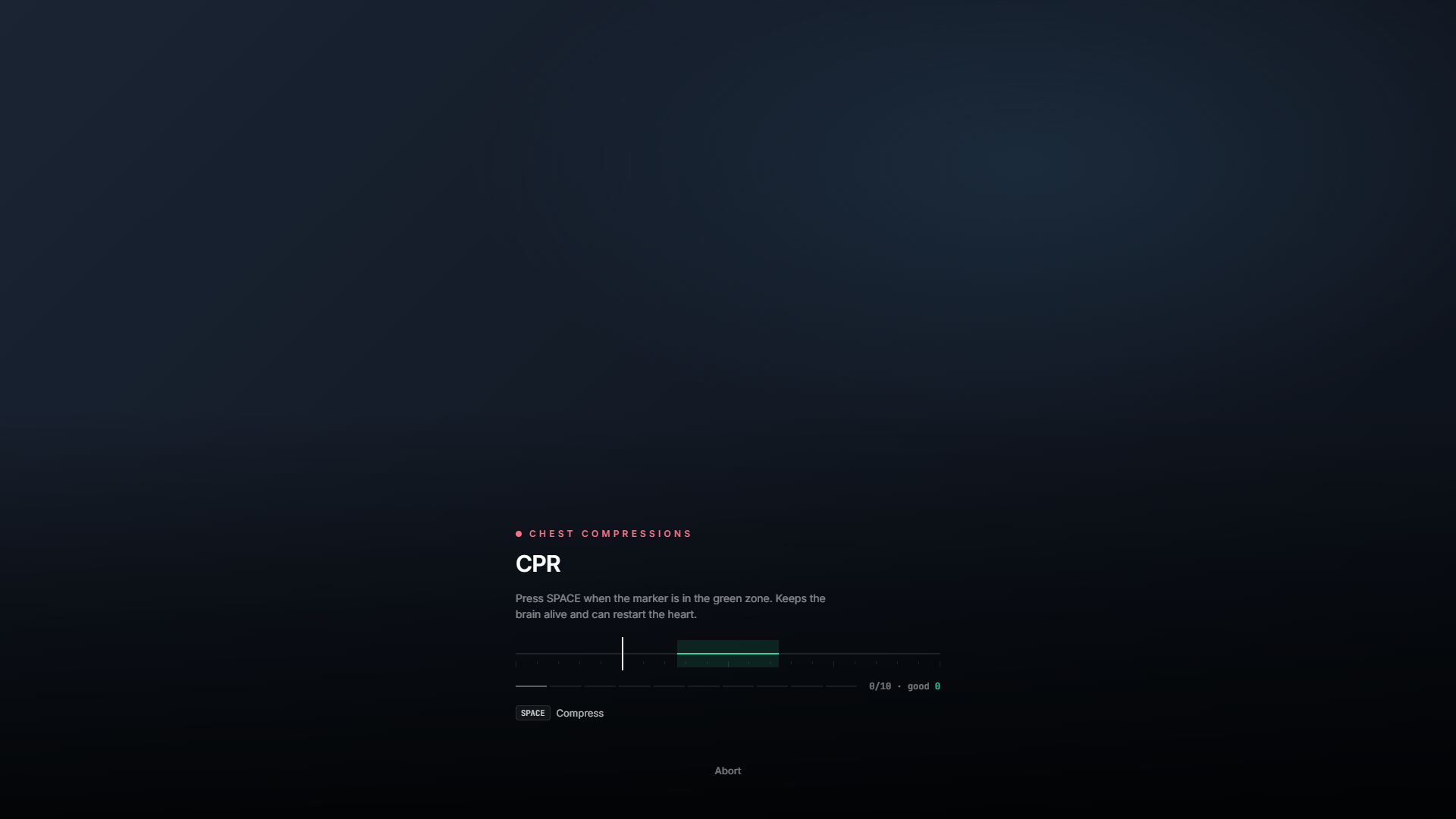
A 12-second rhythm minigame per cycle.
| A successful cycle | |
|---|---|
| Extends the timer | +45 seconds to their bleed-out / brain timer (once per minute) |
| Can convert asystole | 35% chance to turn a flatline back into a shockable rhythm |
| Can achieve ROSC in PEA | 40% chance per cycle, but only with epinephrine on board and enough blood volume |
| Civilian revive | 8% chance for a non-medic to bring a dead patient back to last stand |
CPR is never wasted. Even when it does not convert anything, it is buying the patient time.
You cannot do CPR with a broken arm. You can do it on a patient lying on a stretcher in the low or folded position, riding along while a colleague pushes.
⚡ The defibrillator
Requires the defibrillator item. Charge it, choose your energy, shock.
Base success: 55%
Then modifiers stack on top:
| Modifier | Change |
|---|---|
| Pulseless VT | +8% |
| Torsades | −30% |
| Torsades + magnesium given | penalty removed |
| Epinephrine active | +25% |
| Amiodarone active | +15% |
| 200 joules | +8% |
| 360 joules | +15% |
| 150 joules | +0% |
Worked example
A patient in torsades, with magnesium and epinephrine given, shocked at 360 J:
55%  base
 +0  torsades penalty cancelled by magnesium
+25  epinephrine
+15  360 joules
────
95%  chance of success
Compared to the same patient shocked immediately at 150 J with nothing given: 25%.
This is the whole skill of the job. Drugs first, then shock. A prepared medic nearly quadruples their odds.
Rules
- 8 second cooldown between shocks.
- Shocking a conscious patient hurts them. Check for a pulse first.
🩺 The non-shockable path
PEA and asystole cannot be shocked. Your protocol:
1. CPR                        → buys time, can convert asystole
2. Epinephrine (IV)           → required for ROSC in PEA
3. Fluids - saline or blood   → PEA needs blood volume to get a pulse back
4. Keep doing CPR             → 40% per cycle once epi + volume are there
If the patient bled out, volume is the actual problem. Epinephrine alone will not restart a heart with nothing to pump.
🔁 Reversible causes
Three life threats keep the heart from restarting until you fix them: a tension pneumothorax, a cardiac tamponade and a blocked airway.
| While the cause is untreated | |
|---|---|
| CPR | Keeps blood moving and buys time, but no pulse comes back, not even in PEA with epinephrine |
| Defibrillator | The pulse flickers and is lost |
| Help up | Refused, not stable enough. A first aid kit will not bring them up either |
The message tells you which cause it is. Fix it, then resuscitate.
| Cause | Fix |
|---|---|
| Tension pneumothorax | Needle decompression |
| Blocked airway | Suction (water) or intubation |
| Cardiac tamponade | Pericardiocentesis, hospital only |
A patient who arrests from a tamponade in the field needs CPR all the way to the hospital. See Trauma & Life Threats.
✅ After the save
| A medical revive puts them at 60% health | |
| They need at least 3,000 ml of blood or they collapse straight back down | |
| For 60 seconds they cannot sprint or jump | |
| All their injuries are still there | Treat them properly before discharge |
🧰 The shortcuts
| Item | |
|---|---|
| Revive Kit | Instant revive, medics only. Disabled by default, enable it for low-population servers where realism has to give way to playability |
| First Aid Kit | Civilian item. Brings a downed player up, only once bleeding is controlled. Cannot revive the dead |
⚙️ Tuning it
Everything on this page is in Config.Revive, base chances, bonuses, the rhythm weights per cause of death, the CPR conversion chance, the shockable window. Server owners can make arrests as forgiving or as brutal as they like.