
Rescue
Vehicle extrication
Crash calls spawn a wreck with a trapped casualty. How they are trapped is picked per crash (Config.Extrication):
| Entrapment | What it takes |
|---|---|
| Door | The doors are jammed: force a front door (spreaders, cutter or saw) or flap the roof |
| Dash | Legs pinned under the dashboard: after a front door is off, roll the dash with the rescue ram |
| Under | Pinned under the car outside it: lift the car with the lifting airbags |
The order on scene:
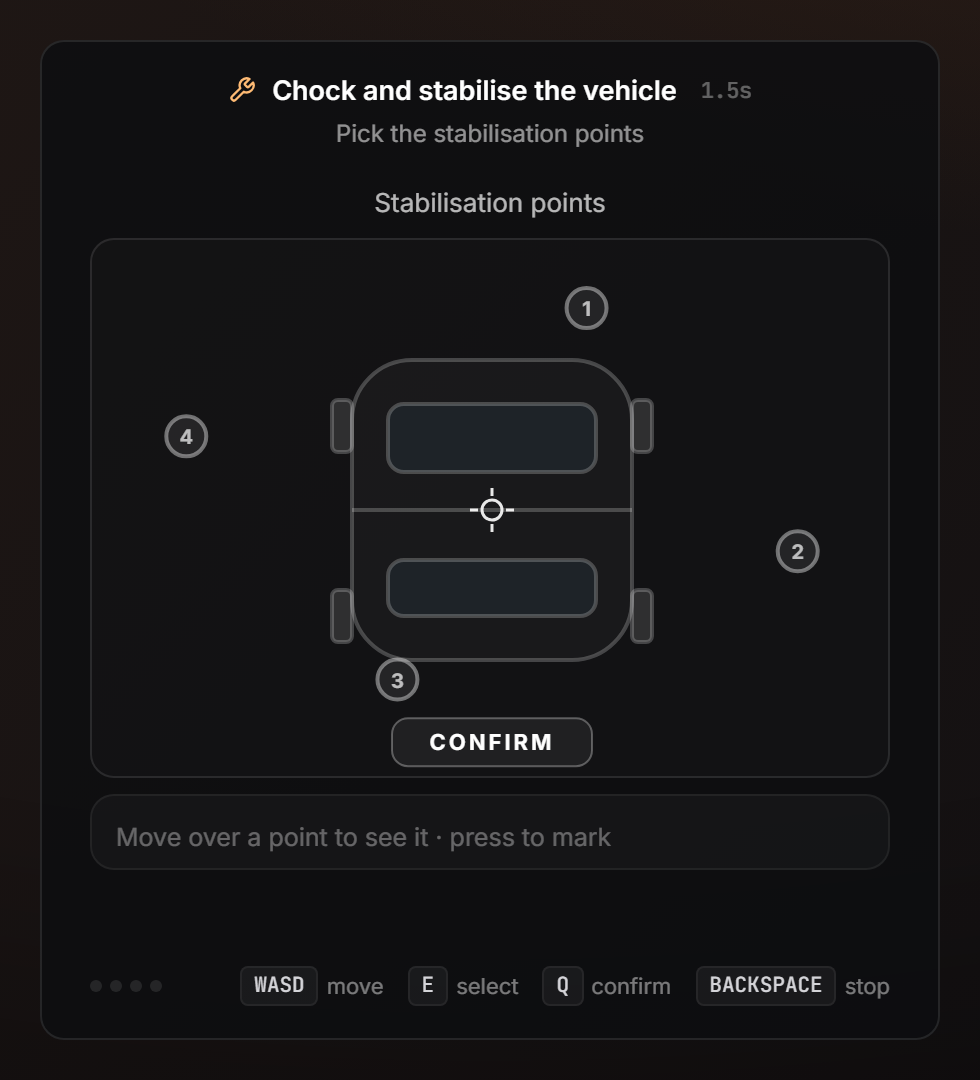
- Stabilise: place at least one stabiliser next to the car, then target it and pick the stabilisation points. Cutting an unstabilised car is refused.
- Battery: pop the bonnet and disconnect the battery. Cutting into a car that still has power can spark a fire in the engine bay (
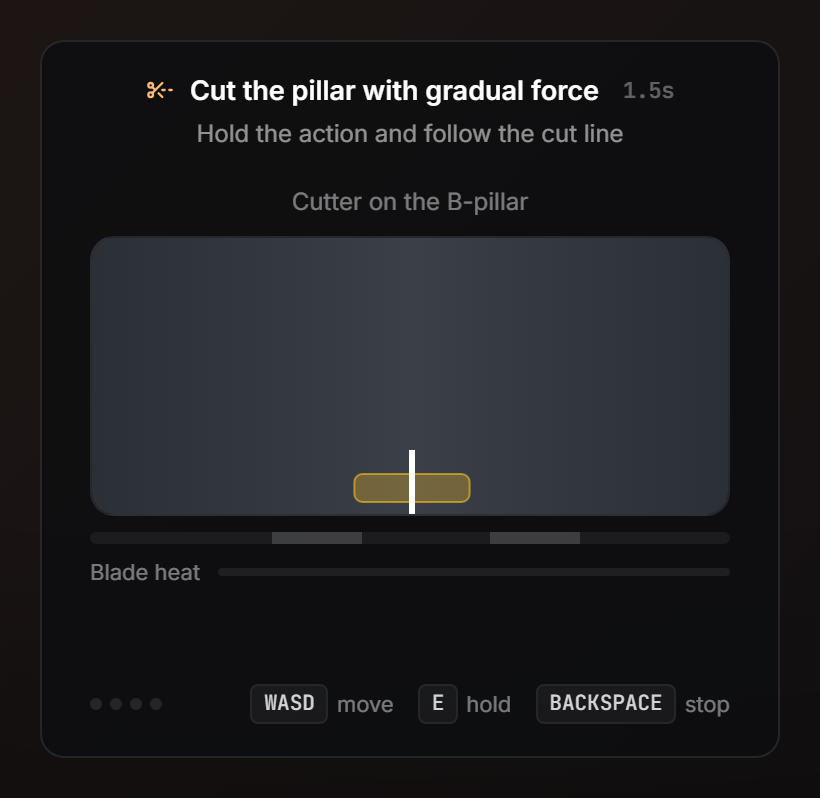
Config.Rescue). - Gain access: force a door, or cut the pillars and fold the roof back (full access, quicker extrication). Pick the cut points carefully: cutting into an airbag inflator or a pretensioner fires it, knocking you down, hurting the patient and halving the rescue bonus.
- Package the casualty (collar, board), then extricate.
The rescuer gets a rescue bonus (Config.Payments.rescueBonus).
Search & rescue
On house, nightclub, industrial and missing person calls the trapped people are hidden in rooms with no markers (Config.Search). Search each room with a right-hand search, or a thermal sweep with the camera. Shift debris first where a room is blocked. The tablet scene map shows which rooms are searched.
Trapped people who are awake call for help, so you can find them by sound in the smoke (Config.Missions.shout). Carry them at least 22 m from the fire to make them safe, or guide out the ones who can walk.
Technical rescue
Rope rescue, confined space and heavy lifting calls are worked step by step (Config.TechRescue). The next step has a marker on scene: target it and do its minigame. The last step brings the person out, ready for first aid.
| Call | Steps |
|---|---|
| Rope rescue | Rig an anchor → tie and check the knots → set edge protection → haul the casualty up with steady winch tension |
| Confined space | Test the air with the 4-gas detector → ventilate with a running fan → set up the generator and lights → rig the tripod → winch the casualty out |
| Heavy lifting | Crib the load with 2 stabilisers → place the lifting airbags under solid points → inflate them slowly and lift |
In a confined space the bad air around the entry hurts anyone without a facepiece on air until it is ventilated. Each rescue can need the Technical rescue certificate (cert).
Building collapse
Victims are buried under the rubble (Config.Collapse). Shore the rubble first (place 2 stabilisers close by), then dig each victim out and carry them clear. Rubble that isn't shored within 8 minutes shifts again: anyone close gets hurt and one buried victim dies. A collapse can also have a gas leak.
Trees down
Cut the tree up with the chainsaw, 3 cuts (Config.Trees). On a tree-on-vehicle call the driver can only be extricated once the tree is off the car.
Power lines down
- Cordon: put out 3 cones or barriers around the line.
- Isolate: at the pole's utility box, ask the power company to cut the power. It takes 2 minutes.
- Put out the electrical fire. No water while it's live: use the extinguisher or foam.
Until the power is off, anyone within 6 m of the line gets shocked (Config.Powerlines).
Water rescue
- Swimmers: launch the rescue boat from the tablet (needs the Rescue boat certificate), tow swimmers to land or pull them into the boat, then CPR.
- Vehicle in water: put on the diving gear, free the driver from the sunk car, bring them up and do CPR.
- Boat fire: needs the fire boat (
predator), which drafts from the sea.
Animal rescue and jumpers
- Cat up high: put the ladder up, grab the cat and give it back to the owner.
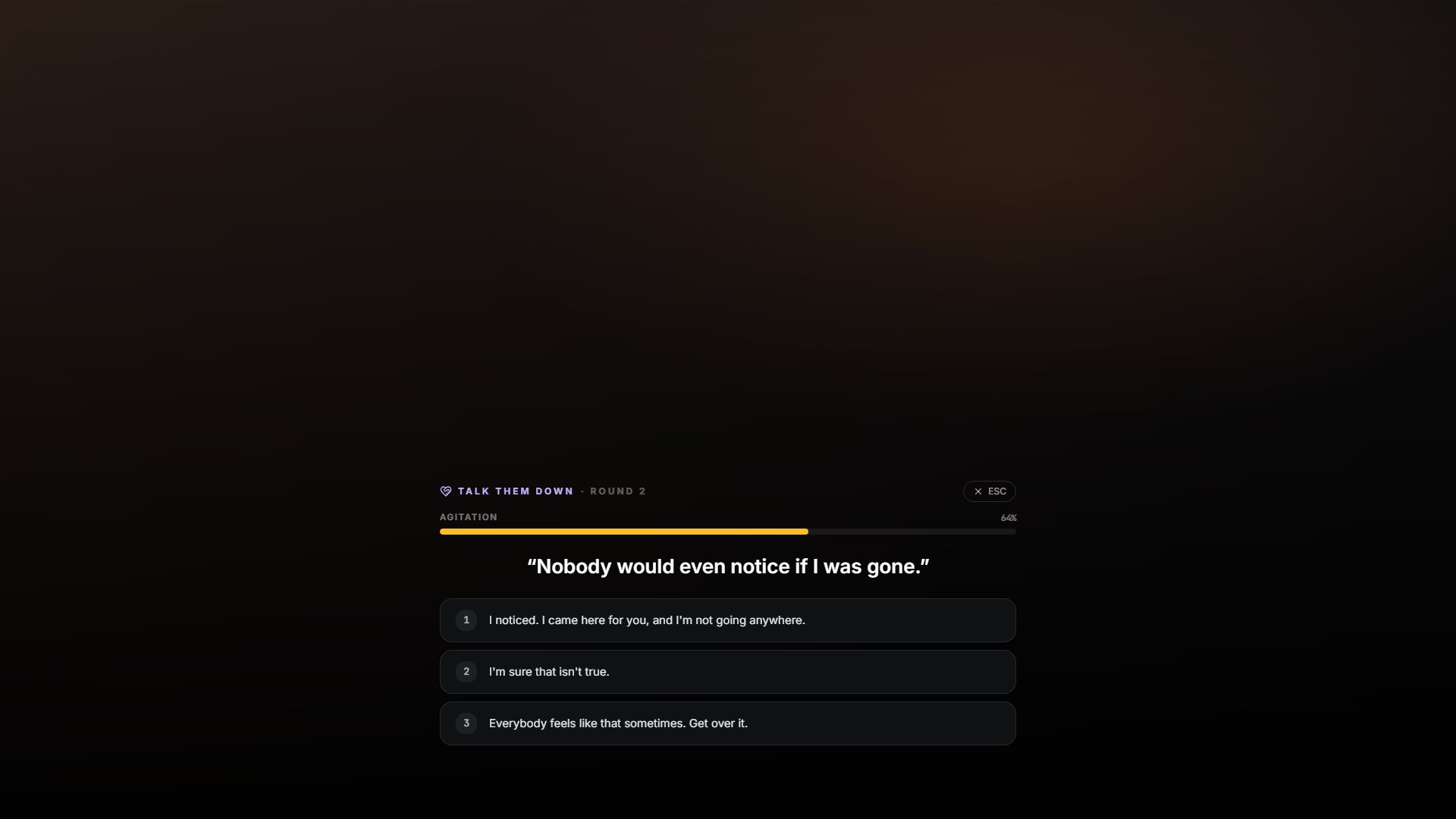
- Person on a ledge: inflate the air cushion below, then talk them down. Choose the right words: wrong ones make it worse (
Config.Negotiation).
Hazmat
On chemical spill calls (Config.Hazmat):
- Identify the product from the safe spot (yellow marker, outside the spill):
- Binoculars: the camera zooms onto the leaking container. Look around with the mouse, scroll to zoom in until the hazard diamond is sharp, and hold it in the middle to read its class and UN number.
- Response guide: type the 4-digit UN number on the keypad. The page shows the product, its hazards, the protection it needs and how far to isolate it. Misread the number and you get the wrong page.
- Find the leak: follow the detector readings to the leaking container.
- Exclusion zone: take traffic cones or barriers from the truck compartment and place 3 at about the guide's isolation distance (30 to 45 m, depending on the product).
- Contain it: turnout gear, facepiece on air and a hazmat spill kit from the truck compartment. Target the spill, check your protective gear, then approach upwind, stop the leak, lay booms, cover with pads, bag the waste.
- Decontaminate at the decon point (green marker, upwind) step by step.
What you do in the hot zone matters:
- Water on a water-reactive product (sulphuric acid): the pool boils and spits a cloud, and the spill grows. The guide says no water.
- A running engine in the vapour of gasoline or propane: the crew gets a warning, and if it keeps running the spill ignites. Shut engines off or move the trucks back.
The hot zone hurts anyone without a facepiece on air, and it drifts downwind with the real wind: come in from downwind and you walk into it sooner. An uncontained spill ignites after a while. The products, placards and guide pages are in Config.Hazmat.products.
Gas leaks
Evacuate the area, find and shut the cylinder before it ignites, ventilate with the fan, and confirm 0% LEL with the gas detector.
Spreaders and cutter on the real door
The spreaders force the real car door: hold E, and let go at each creak so the tips take a fresh bite. The cutter is aimed at each hinge on the door and cuts while you hold E. See Minigames.